
Last Updated on April 5, 2026
In our busy world, the connection we have with ourselves is often the first thing we overlook. However, how to build a healthy relationship with yourself is perhaps the most important skill you can develop for long-term happiness. This post explores the vital connection between self-awareness, self-acceptance, and inner peace in cultivating mental well-being. By the end of this guide, you will discover practical strategies for nurturing your mind, building resilience, and finding calm amidst the chaos.
- The Internal Connection: Why Your Relationship with Yourself Matters
- The Foundation: Improving Self-Awareness and Self-Acceptance
- Identify Your Values
- The Bridge: Self-Acceptance
- Finding Inner Peace: Practical Self-Care Strategies
- Nurturing Your Mental Well-being Through Personal Growth
- How to Build a Healthy Relationship with Yourself: A Holistic Approach
- Debunking Myths About Your Internal Relationship
- The Ongoing Journey
Building on the foundation laid in A Beginner’s Guide for Human Growth and Development, this article delves deeper into how to improve your relationship with yourself.
The Internal Connection: Why Your Relationship with Yourself Matters
In our fast-paced, ever-connected world, it’s easy to get caught up in the whirlwind of external pressures. We often forget the most important relationship of all: the one we have with ourselves. Cultivating mental well-being is not a destination, but a journey. It is a continuous process of self-discovery, acceptance, and growth. It’s about understanding our inner landscape. Additionally, it involves nurturing our minds and fostering a sense of peace amidst the chaos. This post explores the crucial aspects of this internal relationship to help improve your relationship with yourself. It draws inspiration from articles like “Finding Inner Peace: A Guide to Cultivating Mental Well-being” and “Embracing Wholeness: The Journey to Unconditional Self-Love.” Moreover, it connects to related topics that contribute to a holistic approach to mental wellness.
The Foundation: Improving Self-Awareness and Self-Acceptance
The cornerstone of any healthy relationship is self-awareness. Essentially, it is the ability to recognize our thoughts, feelings, and behaviors while understanding how they impact our overall well-being. Without this understanding, we are essentially navigating life without a map. Consequently, we react to situations rather than respond thoughtfully. Therefore, if you are looking into improving self-awareness and self-acceptance, you must start by observing your inner landscape.
How to Improve & Maintain Self-Awareness:
- Journaling: Regularly writing helps you identify patterns and gain clarity.
- Mindfulness & Meditation: These practices allow you to become present without judgment.
- Self-Reflection: Take time to consider your strengths and weaknesses with compassion.
- Know Your Triggers: Identifying what upsets you allows for better emotional management.

In addition to these practices, it is helpful to realize that self-awareness isn’t about self-criticism. Instead, we should aim to be detached observers of our own minds. As a result, we can make conscious choices that support nurturing your mental well-being.
Identify Your Values
What truly matters to you? Understanding your core values helps you make decisions aligned with your authentic self. However, identifying these values requires us to distinguish between what we simply “prefer” and what we recognize as fundamentally right.
When we treat our ethics as mere opinions, we risk falling into the trap of moral relativism. True self-awareness involves recognizing that some values—like the refusal to cause unnecessary harm—are not just personal quirks. For instance, aligning your life with objective truths is a powerful way to strengthen your integrity.
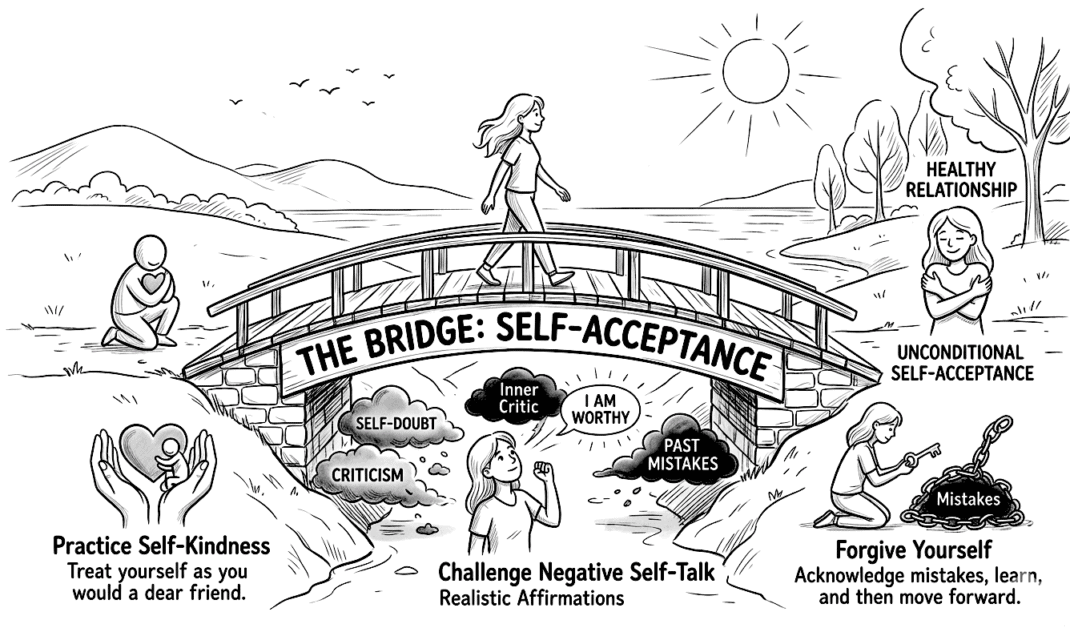
The Bridge: Self-Acceptance
Once we have a clearer picture of ourselves, the next step is self-acceptance. This can be challenging because we often carry narratives of self-doubt. Nevertheless, true mental well-being requires us to embrace our whole selves, including our vulnerabilities. This bridge is essential for building a healthy relationship with yourself.
- Practice Self-Kindness: Treat yourself as you would a dear friend.
- Challenge Negative Self-Talk: Replace the inner critic with realistic affirmations.
- Forgive Yourself: Acknowledge mistakes, learn, and then move forward.
Finding Inner Peace: Practical Self-Care Strategies
In a world that constantly bombards us with demands, finding inner peace can feel impossible. In spite of this, it remains an essential component of health. Inner peace is not the absence of challenges; rather, it is the ability to navigate those challenges with resilience.
Practical Self-Care Strategies:
- Prioritize Physical Health: Physical well-being is intrinsically linked to mental health.
- Set Healthy Boundaries: Learn to say no to things that drain your energy.
- Seek Support: Reaching out to a therapist or friend is a sign of immense strength.
Nurturing Your Mental Well-being Through Personal Growth
Engaging in self-improvement allows you to gain a deeper understanding of your beliefs. Furthermore, as you learn and grow, you build confidence in your abilities. This creates a “snowball effect” where personal growth and inner peace begin to reinforce one another.
To maintain this growth:
- Set realistic, achievable goals.
- Embrace lifelong learning.
- Step outside your comfort zone regularly.
How to Build a Healthy Relationship with Yourself: A Holistic Approach
- The Power of Simplicity: In a world obsessed with achievement, we must stop chasing the extraordinary and start appreciating the ordinary.
- Nourishment from Within: What we eat matters. For example, incorporating dark leafy greens can nourish your mental health.
- Movement and Mind: Even if you feel unmotivated, remember that gym workouts have a transformative power on relaxation.
- Daily Habits: For long-term results, try these 10 free strategies for lasting well-being.
Debunking Myths About Your Internal Relationship

As you work on improving self-awareness and self-acceptance, you may encounter internal resistance or outdated social narratives. To truly move forward, it is essential to clear away these common misconceptions:
Myth: Building a Relationship with Yourself is “Selfish.”
Reality: In truth, you cannot pour from an empty cup. Nurturing your own well-being is a prerequisite for showing up authentically for others. When you are grounded and self-aware, you are better equipped to practice empathy and advocacy in the outside world.
Myth: You have to be Happy all the Time.
Reality: A healthy relationship isn’t about constant positivity. Instead, it is about how you treat yourself when things go wrong. It involves being a supportive ally to yourself during times of grief, anger, or failure, rather than a harsh judge.
Myth: Self-care is Expensive or Time-consuming.
Reality: While spa days are nice, true self-care often involves practical self-care strategies that cost nothing. It can be as simple as setting a boundary, drinking enough water, or practicing 10 minutes of gratitude.
Myth: You are either “Born with” Self-confidence, or you aren’t.
Reality: Self-relationship is a skill, not a static trait. Much like a muscle, your sense of self-worth and inner peace grow stronger the more you consciously exercise them through nurturing your mental well-being.
The Ongoing Journey
The relationship we have with ourselves is a lifelong journey. Admittedly, there will be ups and downs. But by approaching this journey with patience, you create a foundation that cannot be easily shaken. In conclusion, remember that you are worthy of love and well-being exactly as you are today. Continue to nurture that relationship, one step at a time, as you master how to build a healthy relationship with yourself.
“Self-compassion is not self-indulgence. It’s about treating yourself with the same kindness and understanding that you would offer to a good friend.”
– Kristin Neff
Brought to you by The Human Experience from Our Origin Story.


A Canadian animal rights activist, feminist, and mental health advocate with a background in Biotechnology. As a vegan for 10+ years and Founder of The Honest Whisper, she is dedicated to amplifying voices and creating a kinder world for all sentient beings.


